Environmental Stewardship
As a part of its approach to sustainability, American Municipal Power, Inc. (AMP) is committed to environmental stewardship.


AMP is investing in two nature-based solutions to improve the environment. First, AMP has worked with a variety of partners to reforest parts of Ohio. Second, AMP is planting pollinator habitats and promoting the environmental stewardship efforts of its Member communities.
AMP’s Reforestation Projects
Within the Member footprint, AMP partners with government agencies, communities, and private entities to identify, evaluate, and develop reforestation projects. These projects leverage the natural growth of trees to capture carbon dioxide from the atmosphere and store it in biomass and soils over time. As a result, they provide a nature-based carbon sequestration solution alongside broader ecological benefits.
Projects on Strip-mined Lands/American Chestnut
One focus of AMP’s reforestation efforts is the restoration of former strip-mined lands to forested conditions. These projects result in the sequestration of carbon dioxide and provide additional benefits to surrounding communities, including improved visual aesthetics, enhanced wildlife habitat, better water quality and expanded recreational opportunities.
AMP also collaborated with university scientists and foresters to reestablish the American chestnut as a key species in suitable areas. A hybrid strain, well-suited to the higher soil acidity typical of reclaimed mine lands, was selected for planting. Once widespread throughout eastern U.S. forests, the American chestnut was nearly eliminated by a blight in the early 1900s. The efforts align with broader initiatives led by The American Chestnut Foundation to restore the species within its historic range.
Pollinator Efforts
According to the U.S. Department of Agriculture (USDA), three-fourths of the world’s flowering plants and 35 percent of the world’s food crops depend on animal pollinators to reproduce. The USDA also cites habitat loss, disease, parasites and environmental contaminants that have contributed to the decline of many species of pollinators. Utilities can play a vital role in supporting pollinators due to the amount of land they manage.

In 2025, AMP established a pilot pollinator habitat at the AMP Fremont Energy Center (AFEC), planting a mix of native wildflowers on a two-acre plot. The planting was completed by the WR Hunt Club of Clyde, a volunteer group dedicated to pollinator gardens in northwest Ohio. Developed with input from The Ohio State University students, the project is designed to lower long-term maintenance costs and enhance local ecosystems. Monitoring will continue through 2026 to assess outcomes.
Several of AMP’s Members have also installed pollinator habitats.
City of Hamilton Pollinator Habitats
The City of Hamilton Department of Infrastructure manages more than 20 miles of 138-kilovolt transmission lines that support the Greenup and Meldahl hydroelectric plants. In 2019, Hamilton partnered with ACRT, Inc., an independent national vegetation management consulting firm, to convert a number of plots within its transmission rights-of-way into pollinator friendly plots. The conversion of these plots is meant to help protect those transmission lines by removing existing woody growth while also creating conditions for the native seed bed to be released. The native seed bed is rich with milkweed, coneflower, ironweed and butterfly weed, which provide a habitat for butterflies, moths, bees, small mammals, turkey, deer and neotropical songbirds. These native plants also help to combat the encroachment of trees in an environmentally sound and cost-effective way, thereby reducing the maintenance costs in the transmission rights-of-way.
Since converting the plots, the Hamilton Department of Infrastructure has been working with ACRT, Inc., to study the area and determine how well it is supporting monarch and pollinator species. Monitoring of the pollinator sites will continue through 2029.
The City of Hamilton also has multiple pollinator gardens throughout the city.
Other Member Highlights
Member Spotlight: Vegetation Management in Lebanon
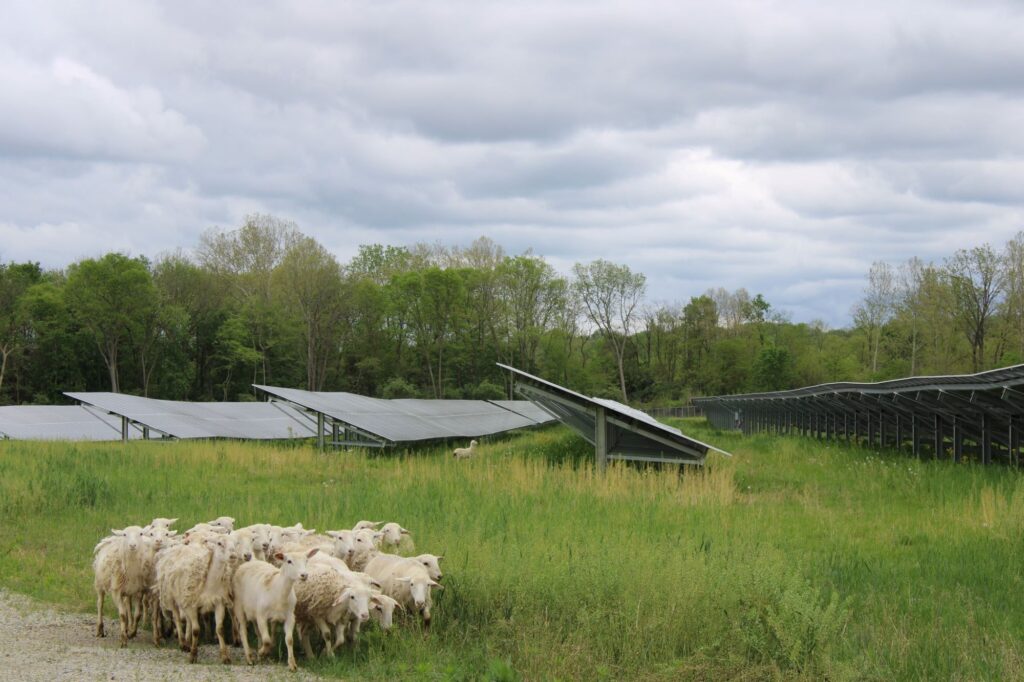
The City of Lebanon Electric Department manages three solar fields that support the city’s electric system and long-term energy goals. To assist with the ongoing maintenance of these sites, Lebanon is using a sustainability grant from AMP’s EcoSmart Choice® program for ongoing maintenance costs associated with vegetation management. As part of this initiative, the city has partnered with Ohio Solar Grazing to implement a sustainable solution for maintaining more than 30 acres of grassland surrounding its solar panel installations.
Rather than relying on traditional mowing methods, Lebanon has introduced a flock of sheep to graze around and beneath the solar panels. This approach effectively controls vegetation and minimizes the risk of damage to panels that could occur when rocks or debris are disturbed by traditional mowing methods. Replacing lawnmowers with sheep also significantly reduces fuel consumption and air pollution, further lowering the city’s environmental footprint and demonstrating its commitment to sustainability and cost-effective operations.
Tree City USA Certified Members
| Bowling Green | Hillsdale | Oberlin |
| Brewster | Hudson | Orrville |
| Bryan | Jackson | Paducah |
| Carey | Lebanon | Pemberville |
| Celina | Lewes (DEMEC) | Piqua |
| Chambersburg | Marshall | Schuylkill Haven |
| Cleveland | Martinsville | Shelby |
| Coldwater | Mifflinburg | St. Clairsville |
| Columbus | Milan | St. Marys |
| Cuyahoga Falls | Milford (DEMEC) | Tipp City |
| Danville | Monroeville | Toledo |
| Dover | Montpelier | Versailles |
| Edgerton | Napoleon | Wadsworth |
| Front Royal | New Castle (DEMEC) | Westerville |
| Hamilton | Oak Harbor |
Bee City USA Certified Members
| Berlin, Md. | Shelby |
| Danville | Wellington |
| Martinsville |